What it is
Dedicated to Nizier, a bishop of Lyon, a church has stood here since the early Middle Ages. As the Presqu'île grew rich after the year 1000, Saint-Nizier grew with it — and into rivalry with the cathedral across the river.
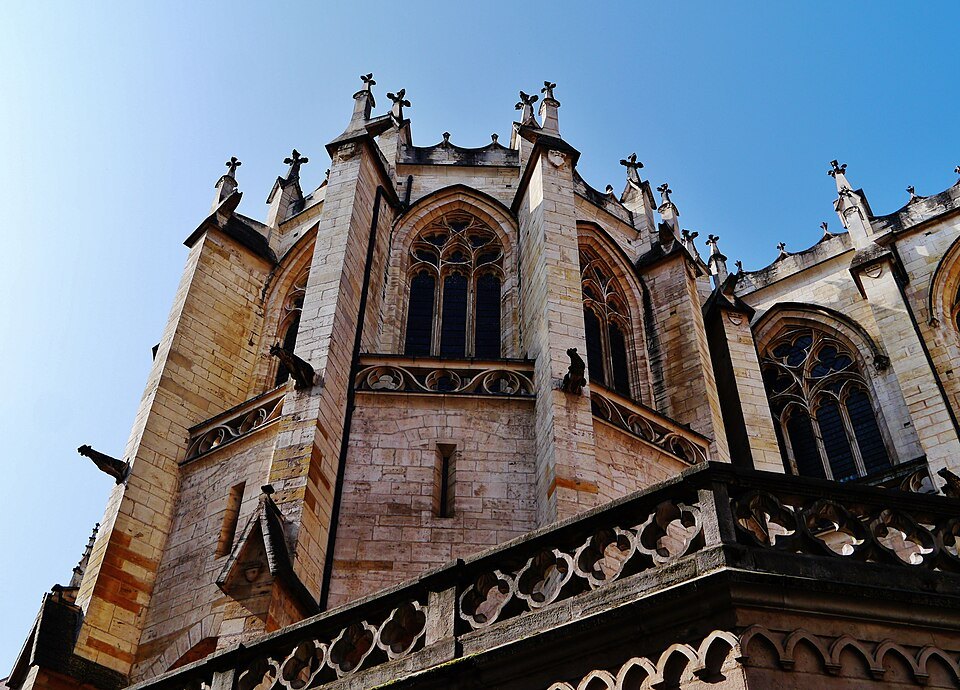
The present church was rebuilt entirely in the fourteenth and fifteenth centuries in flamboyant Gothic, and was among the first buildings protected as historic monuments in France, in 1840.
Getting it right
It stands between the Terreaux and the Place des Jacobins — an easy stop on the walk up the Presqu'île.
On a Roman cemetery
Like several other Lyon churches, Saint-Nizier stands on a cemetery of Roman Lugdunum: epitaphs to the gods of the dead and a Christian epitaph dated 495 have been found nearby. Legends say the site held a temple or a chapel founded by Pothinus, the first bishop, but no serious excavation has ever been made under the church. A papal bull of 1252 claimed it had been the city's first cathedral; modern research shows that the first cathedral, built by Bishop Patiens, stood where Saint-Jean is today.
According to a ninth-century tradition, Bishop Eucherius built a basilica here in the fifth century for the relics of the martyrs of 177, known as the church of the Holy Apostles. The bishops of Lyon were buried in it through the sixth century, among them Nizier, who died in 573; the crowds and miracles at his tomb were such that the church took his name. The crypt where these burials took place still exists, set into the floor of the present church, a small cross-shaped chamber with an apse at the end of each arm.
The townspeople's church
Rebuilt in the ninth century on the orders of Bishop Leidrade, the church became, between the eleventh and fourteenth centuries, the heart of Lyon's merchant class. They made it their main church, in opposition to Saint-Jean and Saint-Just, the churches of the clergy and nobility, and met here to take their common decisions. The present building went up in the fourteenth and fifteenth centuries; the north bell tower was raised in 1481 with the first clock, made by Lyon craftsmen, and the church was finally finished in 1590, still with only one spire. At the end of the Revolution the cathedral was in such bad condition that Saint-Nizier served for a time as the cathedral.
Two unmatched spires
Saint-Nizier is the only church in Lyon in this flamboyant Gothic style, with twisting, flame-like ornament, many carved figures and gargoyles. Its two spires do not match. The south tower was added in the middle of the nineteenth century in neo-Gothic style by the architect Benoit the elder, a follower of Viollet-le-Duc; to build it, an old Renaissance doorway was destroyed and replaced by the present Gothic one, whose ornament was never finished. The lower walls use hard limestone, some of it reused from Roman buildings.
The central doorway is a rarity in Lyon: a Renaissance porch by Jean Vallet, a pupil of Philibert Delorme, carried on four fluted Doric columns and shaped like a half-dome. Its hollow is studded with more than two hundred stone coffers carved with flowers and angels' faces, with a bust of God the Creator at the top. Above the door a Latin text reads "in his temple all proclaim his glory"; the two biblical passages on either side are carved in letters that shrink in size, for reasons still unknown. The statues of Saint Anne, Saint Joachim and Saint Nizier above the porch are by Joseph-Hugues Fabisch, and the Virgin and Child at the top of the gable is by Jean-Marie Bonnassieux. Inside, look for the series of six paintings of the life of the Virgin commissioned in the seventeenth century from the Flemish painter Adrien Dassier. The old churchyard covered only 692 square meters, almost doubled by a burial crypt of 568 square meters beneath it.
June 2, 1975
On June 2, 1975, between one and two hundred Lyon prostitutes occupied the church. They spoke to journalists as women and as mothers, and protested against police harassment, abuses by officers, the lack of effort to find the killers of three of their colleagues, and a law that sent repeat offenders to prison. Their slogan was "we are all prostitutes", a feminist claim that all women lived under male domination.
Restoration work by the historic monuments service and the city had begun in 1973. Since 1983 the parish has been run by religious communities, first a monastic fraternity and, from 1996, the Emmanuel Community. The church's organ, built in 1885 by Joseph Merklin, was damaged during interior restoration and has been silent since about 1975. The church has been a listed historic monument since 1840.
Sources