What it is
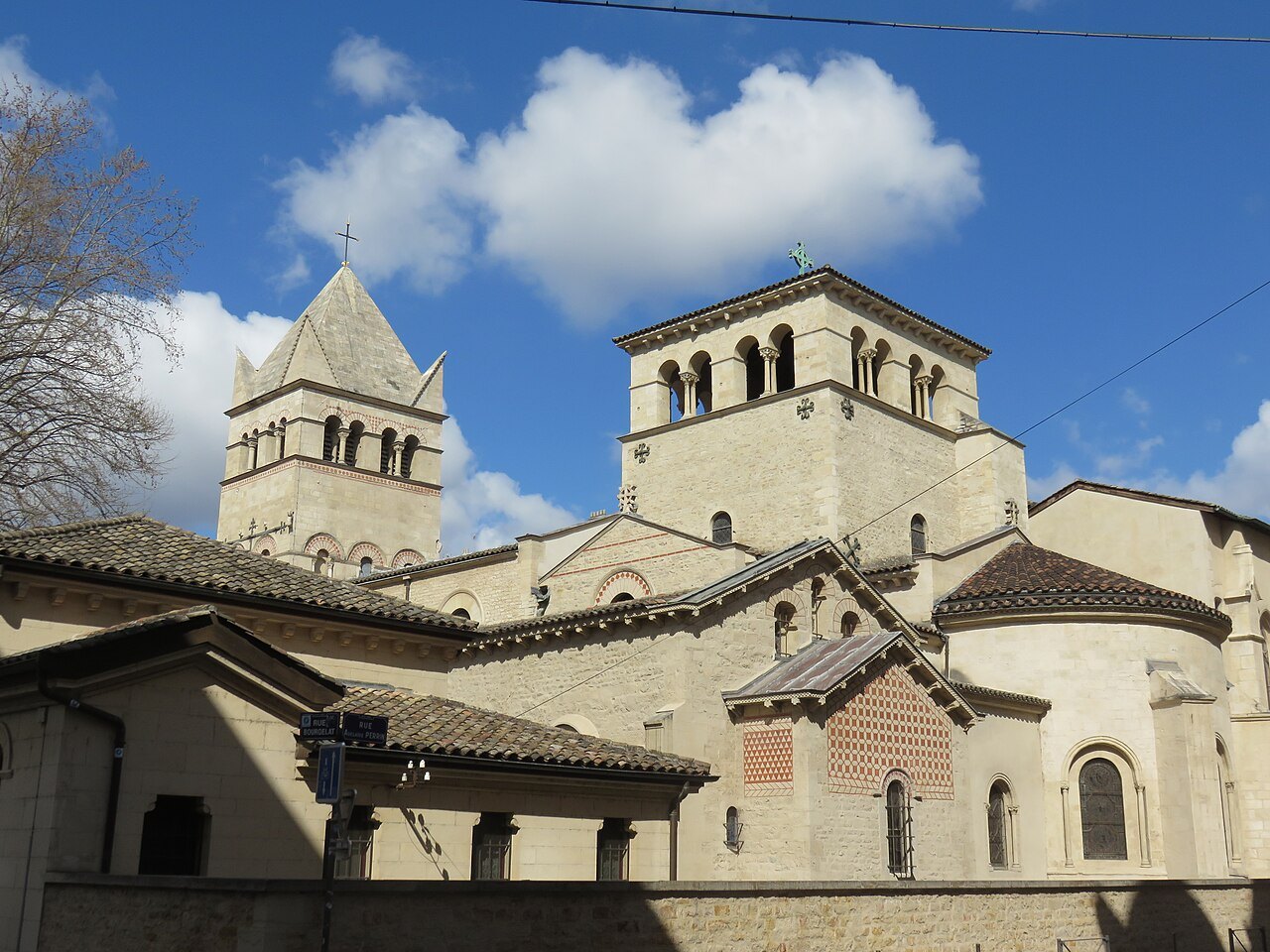
The basilica of Saint-Martin d'Ainay is a former abbey church in the Romanesque style of the twelfth century, in the quiet Ainay quarter south of Bellecour. It was made a minor basilica in 1905.
After the height and light of Gothic, the round arches and heavy stone are a different world. The paintings of the central apse are by Hippolyte Flandrin, from 1855.
Getting it right
Ainay is a residential quarter of handsome streets that few visitors walk. Continue south toward the meeting of the rivers.
Legends and the first records
The monks of Ainay claimed, on the strength of a passage in Gregory of Tours, that their church had been founded in the fifth century where the remains of the martyrs of Lyon were found, and they displayed a bag of ashes and a stone on which Bishop Pothinus was said to have laid his head. Modern historians are skeptical: Gregory's text is vague, and another tradition places the discovery at Saint-Nizier. Another legend credits a hermit named Badulphe. The first reliable mention of the abbey dates from 859.
The abbey played a central part in the Fête des Merveilles, a festival attributed to Saint Badulphe, and every June 2 it celebrated Saint Pothinus and the martyrs, one of the great feasts of the monastery's year. Between 1313 and 1324 Abbot Jean II de la Palud built a palace within the monastery.
The abbey church was built at the end of the eleventh century under Abbot Josserand de Foudras and dedicated to Saint Martin by Pope Paschal II on January 29, 1107. It is one of the few Romanesque churches that survive in Lyon. In the thirteenth century, at the first Council of Lyon, Pope Innocent IV confirmed the abbey's authority over 71 churches, abbeys and priories from Burgundy to Provence, making it one of the most powerful in the kingdom.
Decline and survival
By the Renaissance the monastery had its own port, an abbot's palace, a cloister, gardens and vines. From 1504 the king appointed absentee abbots, and decline set in; land was sold off for new streets. In 1562 the troops of the Baron des Adrets razed the cloister, ransacked the church and burned the archives. Henri IV stayed at the abbey in 1600 for his marriage to Marie de' Medici, and Louis XIV lodged there four times. Camille de Neufville de Villeroy, named abbot at the age of five, later became archbishop and had the abbey secularized in 1685.
At the Revolution the monastery was confiscated and the abbots' palace pulled down, but the church was used as a grain store, which saved it. It reopened for worship in 1802, and in the nineteenth century the architects Pollet and Benoît restored it in a "pure Romanesque" spirit, adding side chapels and destroying the last traces of the cloister. Medieval mosaics found in the Sainte-Blandine chapel in 1844–1845 were destroyed for lack of interest; another, found near the high altar in 1851, showing a churchman holding a model of the church, was the only medieval mosaic discovered in Lyon in that century and was restored. Pope Pius X made the church a minor basilica on June 13, 1905.
What to look at
The bell tower over the entrance rises to 31 meters; its base, built of stone taken from ancient monuments, dates from the eleventh century, and the tympanum over the door is by Joseph-Hugues Fabisch, 1860. Walk around the back to see two different east ends: the square one of the Sainte-Blandine chapel, from the early Middle Ages, and the round twelfth-century apse of Saint-Martin.
Inside, the four great gray granite columns at the crossing are thought to come from the imperial altar of the federal sanctuary of the Three Gauls, each cut in two and reused here. The Sainte-Blandine chapel, the oldest part, has a crypt with a floor mosaic bearing the names of the Lyon martyrs. The Saint-Michel chapel is flamboyant Gothic, rebuilt shortly before 1485, with stained glass by Lucien Bégule. The gilded and enameled copper chandelier under the dome, made around 1860, is modeled on the one Frederick Barbarossa gave to Aachen cathedral and represents the walls and towers of a city.
The church is 37 meters long and its nave 17 meters wide. The capitals at the crossing look ancient but are not; they were carved in imitation of antique models. On the forecourt, to the left of the door, is a carved relief of the eleventh century; the one outside is a copy, and the original is inside. The paintings of the central apse are by Hippolyte Flandrin, 1855. The church's first great organ, built between 1847 and 1850, was sold secondhand in 1864 to Lyon's Great Synagogue, then newly built.
Sources


