What it is
The Terreaux sits at the north end of the Presqu'île, where the slopes of the Croix-Rousse begin. The Hôtel de Ville fills its east side and the Palais Saint-Pierre, home of the fine-arts museum, its south. The name is usually traced to a ditch that ran here until the sixteenth century.
The fountain
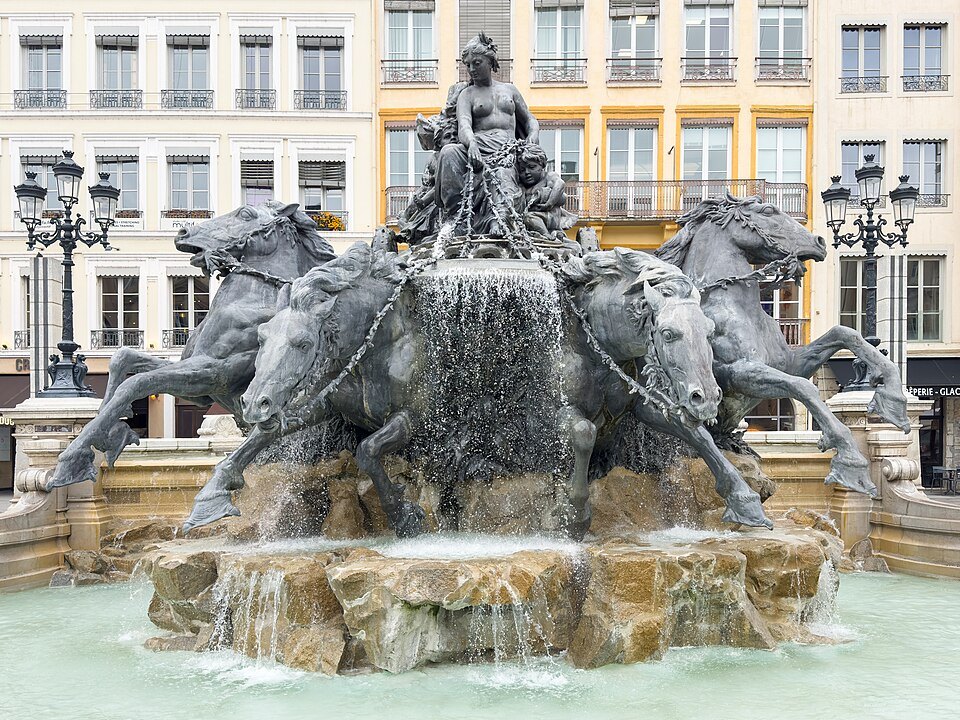
The great fountain is by Frédéric Auguste Bartholdi — the sculptor of the Statue of Liberty — and it was not made for Lyon. Bartholdi designed it as a young man for a competition in Bordeaux, which never went ahead with it. Finished decades later, it was inaugurated here in 1892: a chariot of four rearing horses, officially titled The rivers and springs flowing to the ocean.
Getting it right
The square is at its best in the evening, with the town hall lit. The cafés on its north side look straight at the fountain.
A square built on a moat
The name is usually traced to the Latin terralia, ditches, because a defensive ditch ran here until the sixteenth century. In 1206 Lyon's merchants, in conflict with Archbishop Renaud de Forez over taxes, began a wall at the foot of the slope to protect the Saint-Nizier quarter. The archbishop answered with force in 1208, but he and his successors went on to build a stronger wall right across the peninsula from the Saône to the Rhône: about 500 meters long, two meters thick and ten meters high, with ten towers, two gates with drawbridges, and a moat 22 meters wide that could be flooded in a siege.
By the sixteenth century the walls were crumbling. Demolition began in 1538, the nuns of Saint-Pierre were allowed in 1555 to take its stones for their convent, the ground of the present square was filled in in 1578, and in 1617 the last of the ditch disappeared under the gardens of the town hall, where the opera house now stands.
Markets and executions
The new square held a pig market until 1646 and, for centuries, public executions. On September 12, 1642, the Marquis de Cinq-Mars, who had conspired against Cardinal Richelieu, was beheaded here with his accomplice François-Auguste de Thou. During the Revolution the guillotine stood on the square, and after the siege of Lyon a revolutionary tribunal had 79 people beheaded here. Briefly renamed Place de la Liberté in 1792, it soon took back its old name.
The buildings that frame it went up in the seventeenth century: the town hall from 1646 to 1651 on the east side, and between 1659 and 1687 the rebuilt abbey of Saint-Pierre on the south, now the fine arts museum. The west side, with its arcade, dates from the Second Empire, when the prefect Vaïsse widened the approaches and opened the Passage des Terreaux in 1855.
A fountain meant for Bordeaux
An earlier fountain, the Tourny fountain, was inaugurated in the center of the square on August 15, 1857, and moved to Place Guichard in 1892 to make room for Bartholdi's. That one had been ordered by the city council of Bordeaux in 1857 as the Triumphal Chariot of the Garonne: a woman driving four horses, standing for the Garonne and its tributaries flowing into the ocean. After the Universal Exposition of 1889 Bordeaux found it too expensive, and in 1890 Lyon's mayor, Antoine Gailleton, bought it. It was inaugurated on September 22, 1892, facing the town hall.
It was moved to its current position, in line with the Palais Saint-Pierre, when an underground parking garage was built, and was classified as a historic monument on September 29, 1995. Taken apart and restored in Paris from 2016, it was reassembled and reinaugurated on the evening of March 22, 2018.
Buren's stripes
In 1994 the square was redesigned by the architect Christian Drevet, the lighting designer Laurent Fachard and the artist Daniel Buren, with a grid of 68 small fountains with jets of varying height, lit at night, set in granite paving and bordered by 14 pillars in Buren's black and white stripes. The design even went to court: when postcard publishers reproduced views of the square, Buren and Drevet sued for infringement, but France's highest court ruled that their work was only an accessory element of the square, not the subject of the photographs. The square was renovated again from 2018 in consultation with both men: the 68 fountains, out of order for about a decade, were replaced by a central line of 15 round ones rising as high as a meter and a half, the paving went from dark to light gray, and the work was finished on November 28, 2019, in time for the Festival of Lights. Critics complained that the pale paving shows dirt and that the square still has no trees.
During the Festival of Lights
Every December the Terreaux is the busiest place of all during the Fête des Lumières; nearly a million people came to the square during the 2024 edition. The tradition is for short films of sound and light to be projected onto the facades of the town hall and the fine arts museum.
Sources