What it is
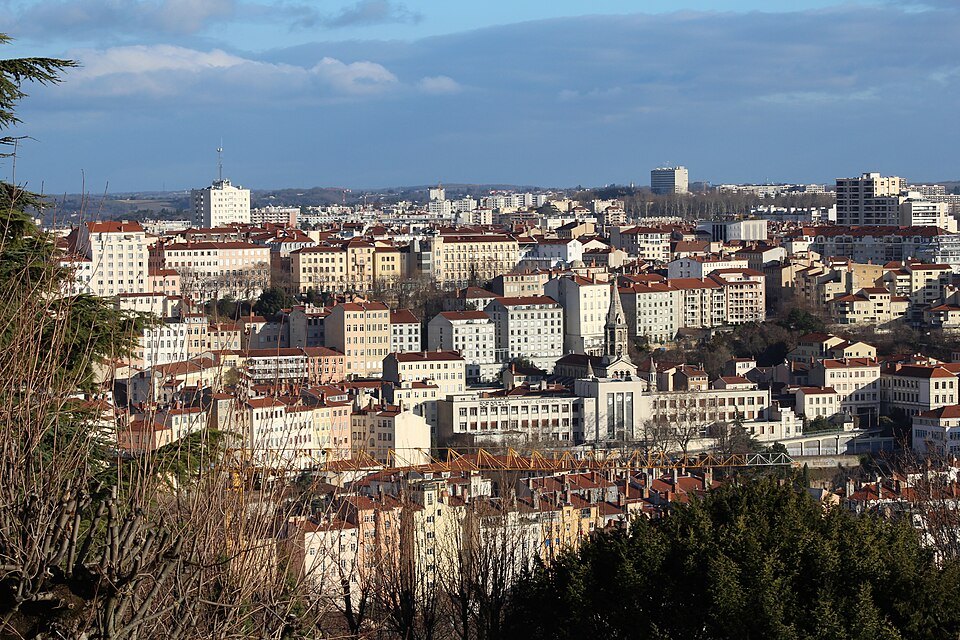
The Croix-Rousse is the hill north of the Presqu'île, between the Rhône and the Saône, topping out at 254 metres. Lyon calls it la colline qui travaille, the hill that works, opposite Fourvière, the hill that prays.
It was the quarter of the canuts, the silk weavers. Their buildings are easy to recognise: tall, with very high ceilings and big windows, because they were built to hold Jacquard looms and to let in light to work by.
The canuts
The silk trade made Lyon the first working-class city of France in the eighteenth century. The canuts are remembered above all for their revolts in the nineteenth century, which influenced social thinkers from the Saint-Simonians to Marx.
The Maison des Canuts keeps working looms and shows how the trade worked.
Getting it right
Walk the slopes — the pentes — rather than riding to the top: that is where the traboules and the stairways are. Metro line C climbs the hill if you want to go up first and walk down.
A hill made by a glacier
The Croix-Rousse rises to 254 meters between the Rhône and the Saône, and its summit is the end of a glacial moraine, rock carried here by Alpine glaciers. The best proof sits at the east end of the boulevard: the Gros Caillou, a boulder of quartzite from the Vanoise in the Alps. Workers digging the tunnel for the funicular in 1862 ran into it and could not break it; it had to be dug out whole, which delayed the work. Set up on the boulevard overlooking the Rhône and the plain toward the Alps, it became a symbol of Lyonnais persistence and of the Croix-Rousse joining the city. It was later moved about thirty meters when a parking garage and park were built beneath it.
From vineyards to looms
In Roman times the lower slopes held the federal sanctuary of the Three Gauls, with its altar and amphitheater, and in 1528 two large fragments of the Claudian Table were found in a vineyard halfway up the hill. For centuries afterwards the slopes and plateau were farmland and vineyards. Building on the slopes began in the Renaissance, when Lyon grew beyond its walls at the Terreaux, and a new rampart along the top of the hill, begun in 1512, cut off the plateau as a separate suburb.
In the nineteenth century the hill became Lyon's industrial quarter. Apartment buildings of five or six floors went up with workshops and flats built with very high ceilings to fit Jacquard looms, invented in 1801, which stood on average about four meters tall. In 1852 the commune of the Croix-Rousse, by then home to 30,000 people, was joined to Lyon, and the prefect Claude-Marius Vaïsse launched major works, including a drinking water network and the Croix-Rousse hospital. The rampart, torn down in 1793 and rebuilt under the July Monarchy, came down for good in 1865 to make way for the wide, tree-lined boulevard along the top.
The canut revolts
The silk weavers worked in harsh conditions and rose up again and again. In October 1831 they occupied Lyon under the slogan "Live free working or die fighting"; the government of Louis-Philippe sent 20,000 troops and 150 cannon to put the revolt down. On February 14, 1834, they rose again, occupying the forts of the Croix-Rousse and holding out for six days against 12,000 soldiers. A third insurrection in 1848, at the proclamation of the Second Republic, and a fourth in 1849 were led by the group known as the Voraces. These uprisings inspired thinkers of the century, among them Proudhon, Saint-Simon, Fourier and Marx.
Getting up the hill
The slopes are so steep that many streets are called montées, climbs. In 1862 the world's first urban funicular opened between Rue Terme and the boulevard, nicknamed la ficelle, the string, by the Lyonnais; it closed in 1967 and became a road tunnel. A second funicular of 1891 from Croix-Paquet was absorbed into metro line C, which still uses a rack section on the climb. Since 1952 a road tunnel has run under the hill from the Rhône to the Saône, joined in 2013 by a second tube for buses, bicycles and walkers.
Up on the plateau the atmosphere is still that of a village, with bowling grounds such as the Clos Jouve and the daily "little market" on Place de la Croix-Rousse, surrounded by bistros. Lyon calls this the hill that works, in answer to Fourvière, the hill that prays. The textile trade suffered a severe crisis in the 1980s, and the few firms that survived did so by turning to technical or luxury fabrics. On the slopes, renovation has brought in younger residents and cultural life, while the quarter has so far kept a genuine social mix.
Sources