What it is
The largest Renaissance ensemble in Vieux Lyon, the Hôtel de Gadagne grew from a fourteenth-century house into a great merchant's mansion. It now holds two museums: the Musée d'Histoire de Lyon and the Musée des Arts de la Marionnette.
What to see
The puppet museum is where to meet Guignol, the puppet created in Lyon at the start of the nineteenth century who became the character of French puppet theatre. The history museum walks through the city from Lugdunum to the present.
There is a small puppet theatre, and a hanging garden high above the quarter.
Rich as Gadagne
The building began in the fourteenth century as a luxurious house on a long plot running from the Montée Saint-Barthélemy down to what is now Rue Saint-Jean, with an ice house, stained glass and glazed tiles. Between 1489 and 1492 the Pierrevive brothers bought it and began a major rebuilding, and in 1538 the merchant-banker Thomas II de Gadagne rented part of it. His sons Guillaume and Thomas III bought the building in 1545 and remodeled it at once. They got on so badly that each lived in one of the two main wings, which did not stop them from giving lavish parties; they kept it until 1581.
The Gadagne, or Guadagni, were a rich Florentine family established in Lyon from the early fifteenth century, and their fortune gave the city a saying: rich as Gadagne. Thomas I de Gadagne was by far the richest man in Lyon, lending to several kings of France and financing an expedition to the New World; he gave Louise of Savoy part of the ransom that freed King François I after his capture at Pavia in 1525.
Saved by the city
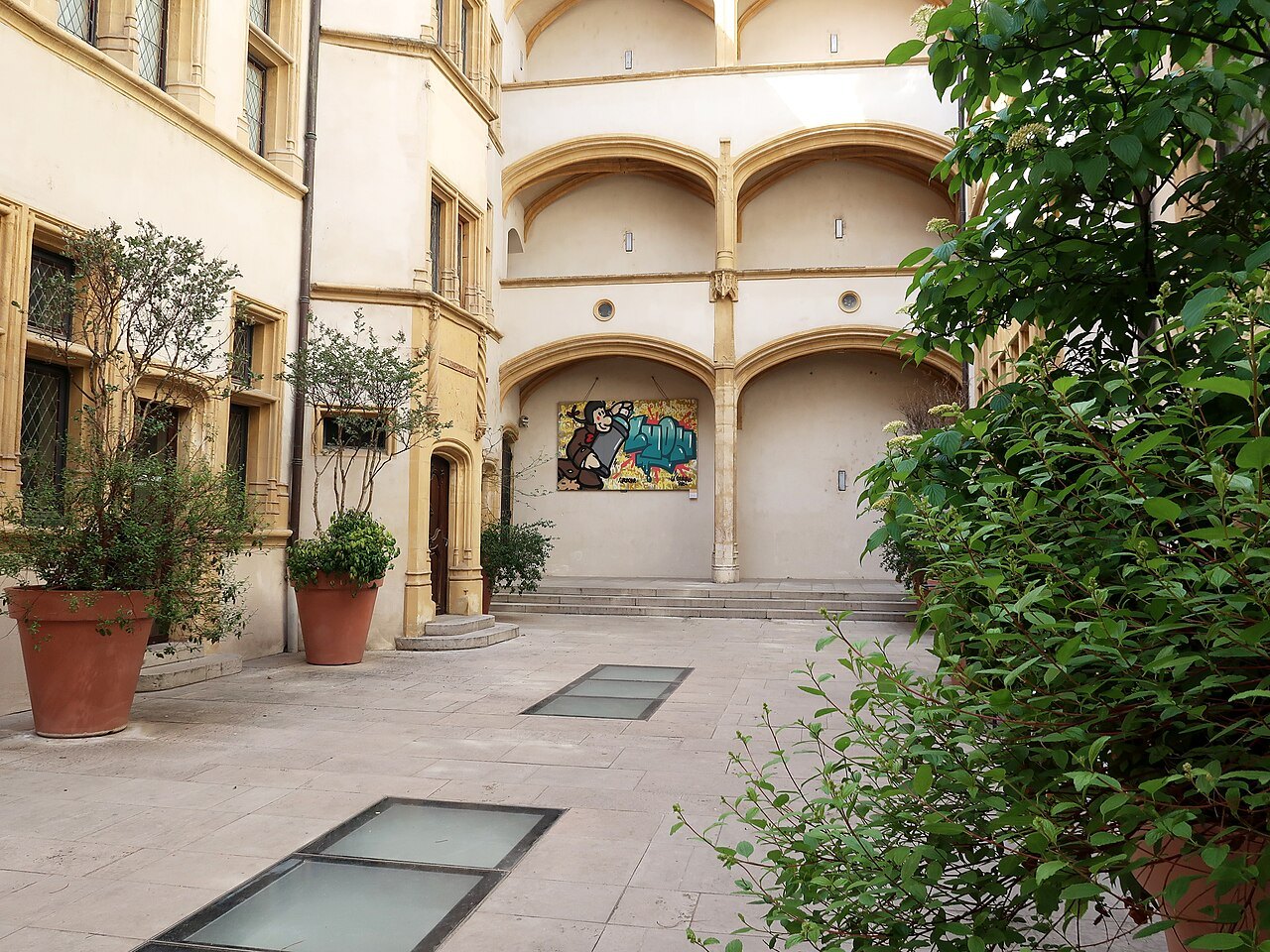
In the eighteenth century the mansion was cut up into small lodgings. The city began buying it in 1902 and completed the purchase in stages by 1941; it was classified as a historic monument in 1920. Today you climb a ramp to the entrance and come into a large courtyard with a well, closed at the back by stacked galleries that link the two main buildings on every floor.
The idea of a museum of Lyon's history had been put forward as early as 1874, and it took almost fifty years. Mayor Édouard Herriot opened the first rooms on July 2, 1921. The core collection came from earlier groups that had been scattered, including nearly 10,000 objects collected by Sébastien-Louis Rosaz and bought in 1846. After a long renovation and extension, with major archaeological digs, Gadagne closed in 2003 and reopened fully on June 12, 2009.
The history museum
From 2019 the history museum rebuilt its permanent route in four parts, one opening each year until 2024: portraits of the city through time; life with the Rhône and the Saône; the working and industrial history of Lyon; and politics, power and the people of the city. The collections lean toward prints, pewter, faience and furniture, among them a set of four gilded armchairs attributed to Pierre Nogaret, rare in eighteenth-century Lyon production, and they cover freemasonry and the trade guilds as well as the papers of political figures such as Édouard Herriot.
Guignol and the puppet museum
The puppet museum is built around the original Guignol. The glove puppet was created in Lyon around 1808 by Laurent Mourguet, and the word now also means the comic puppet theater in which Guignol plays the lead with his friends Gnafron and Madelon. At first the shows were improvised, a kind of comic local news; the written repertoire of nearly fifty plays begins in 1852, when the plays had to be submitted to the censor. Nobody agrees on where the name came from: one story says a neighbor of Mourguet's kept saying his jokes were guignolant, another that Guignol was the name of a Lyon silk weaver.
The shows are played in a small puppet booth, the castelet, with glove puppets whose particular movements and oversized props create the kind of situation comedy found in the commedia dell'arte. Guignol has become an emblem of Lyon: the keeper of its dialect and nineteenth-century traditions, and the inspiration for theaters, companies, a large literature and even a satirical television show.
Puppets have been part of the museum since 1950, and since the renovation they have had their own separate museum, renamed the Musée des Arts de la Marionnette in 2017. Its displays change every four years; in June 2022, 60 percent of the route was renewed with 110 new objects. The route is organized around four questions: what a puppet is, where puppets come from, what they are for, and how they are played, with a large place given to contemporary artists and companies. There is also a small puppet theater, and a hanging garden overlooking the city.
Sources