What they are
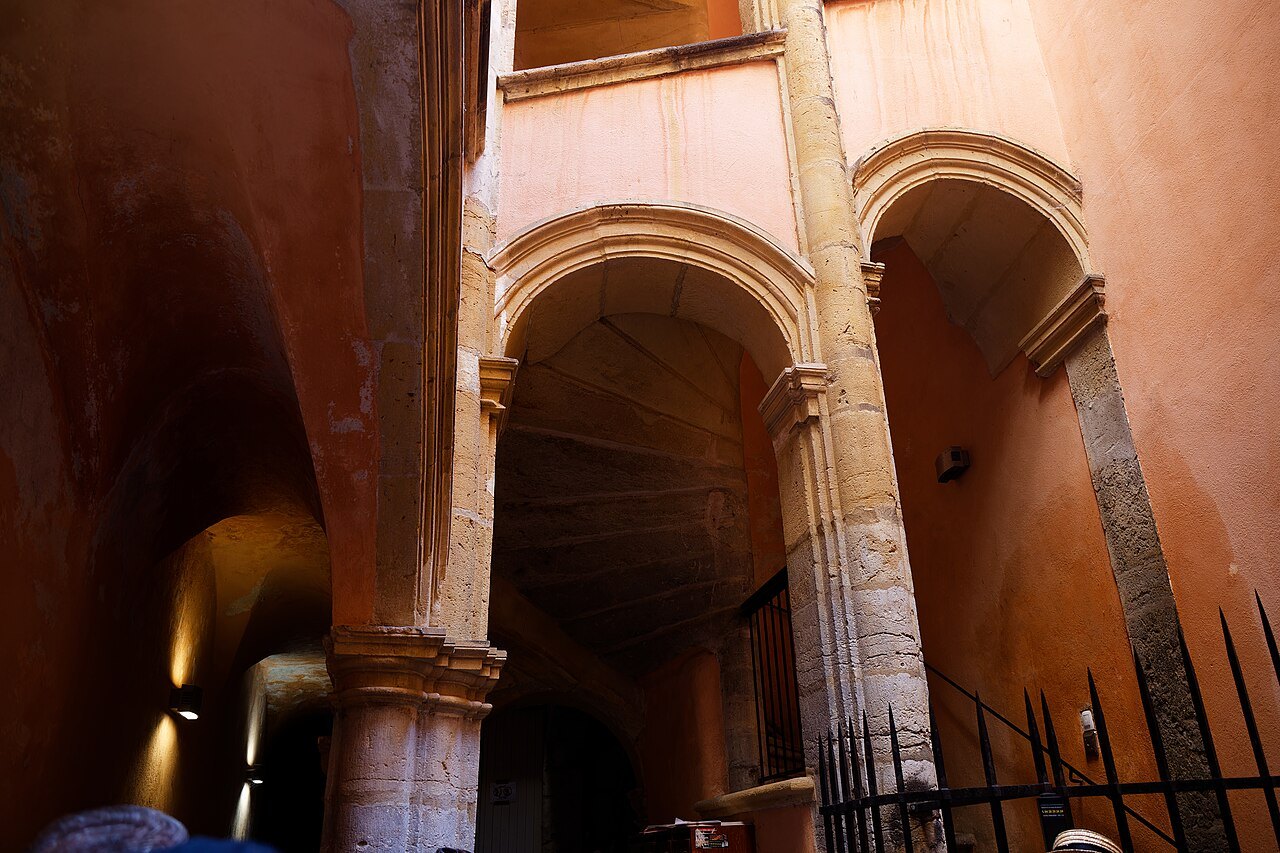
A traboule is a pedestrian passage that runs through a building and its courtyards, linking one street to another. The word is Lyonnais — an old way of saying a passage that goes through. Other towns have them, but Lyon's are the famous ones.
They come in several shapes: straight through, where you can see the exit from the entrance; around a corner, through two buildings; or opening off a single courtyard in several directions. Some climb staircases, because the streets they join sit at very different heights.
Where they are
The two great concentrations are in Vieux Lyon, where they run parallel to the Saône between the long streets, and on the slopes of the Croix-Rousse, where they let the silk weavers carry cloth downhill without going round by the road.
Getting it right
A traboule is a way through somebody's home, not a museum corridor. Only some are open to the public, usually by an agreement with the city; push a door only where it is marked, keep your voice down, and leave the letterboxes and stairs alone.
The tourist office publishes which ones are open. Without it you will spend a morning trying locked doors.
Four kinds of traboule
Lyon's traboules come in recognizable types. A direct traboule lets you see the exit from the entrance. A corner traboule cuts through two or more buildings at the angle of two streets. A radiating traboule is a courtyard in the middle of a block with several ways out. And some simply wander, with turns and staircases, because the streets they connect sit at very different heights. Many combine all of these.
There are about 500 in the city: some 215 courtyards and traboules recorded in Vieux Lyon, 163 on the slopes of the Croix-Rousse and 130 on the Presqu'île. Around forty are open to the public free of charge under agreements between the city and the owners; in exchange for a right of way, the city helps pay for cleaning, lighting and maintenance and covers 70 percent of approved restoration work, because most of these places remain private property.
Where the word comes from
Traboule is Lyon's own word, from the verb trabouler, which first appeared only in the phrase allée qui traboule, a passage that goes through. A popular theory, usually credited to the archaeologist Amable Audin, derives it from a Latin transambulare, to walk across, but linguists doubt it; the dictionary of French regional words simply calls the origin obscure. Another suggestion is that it blends traverser, to cross, with débouler, to tumble down, which would fit passages descending the Croix-Rousse slopes. The first written use dates from 1875, and it already refers to the old Lyon dialect.
Two quarters, two eras
In Vieux Lyon the traboules date from the Renaissance and follow the plan of a Roman patio, with galleries around a courtyard and a well in the middle. On the Croix-Rousse they are younger, built with the nineteenth-century apartment blocks of the silk weavers, the canuts, and they let people come down from the slopes to the Presqu'île in a straight line; many lead to the Montée de la Grande-Côte.
That street is worth walking for its own sake. It climbs 400 meters from Place des Capucins to the Croix-Rousse plateau and was the weavers' route down to the cloth merchants: in 1788 it already counted 705 looms, and the protesters of the canut revolt of 1831 came down it. Its upper section, cleared in the 1970s, was rebuilt from 1999 as the Jardin de la Grande Côte, with a broad view over the city.
Two traboules with stories
The most famous is the Cour des Voraces, built around 1840, which runs from 9 Place Colbert to 14 Montée Saint-Sébastien and 29 Rue Imbert-Colomès. Its courtyard is dominated by a monumental open staircase six floors high. It probably takes its name from the Voraces, a group of weavers known for their republican uprisings of 1848 and 1849, and a plaque recalls the canuts who fought there for their living conditions and dignity. During the Second World War, Lyon's dark and little-known traboules helped Resistance networks evade the occupiers, and the Cour des Voraces is often cited as a symbol of that resistance. In 1995 the housing charity Habitat et Humanisme bought and restored it.
The Passage Thiaffait, built in 1827, enters through a portico on Rue René-Leynaud and ends in a double staircase climbing to Rue Burdeau. By the 1980s it had become one of the most dangerous places in Lyon, its flats squatted and its passages used for crime. It was renovated between 1997 and 2001, and its shops became studios for young fashion designers, now known as the Village des Créateurs; its success helped launch the renewal of the whole Grande Côte quarter.
Sources
- Traboule — Wikipédia (French)
- Cour des Voraces — Wikipédia (French)
- Passage Thiaffait — Wikipédia (French)
- Montée de la Grande-Côte — Wikipédia (French)


